
A fat-quarter count becomes useful when a pattern or cut list tells you how many identical squares you need, but the fabric is sold as separate fat quarters rather than one continuous yardage cut. The decision is a whole-piece purchase: each fat quarter contributes a measured grid of equal squares, and the final count rounds up to complete pieces.
The key measurement is the usable rectangle you will actually cut. Fat-quarter names and package descriptions can vary, so the calculation keeps width and length editable. The example below uses a 31-square requirement and an 18 × 21 inch measured piece to show the difference between per-piece yield, pieces to buy and extra capacity.
When a fat-quarter count helps
Use this decision when the project repeats one square size and you want to buy enough same-size fat quarters to cover that count. It works well for a single fabric role or for a role whose squares can be supplied by interchangeable pieces. It does not combine different square sizes, assign colors, or optimize leftover strips from a mixed cut list.
Start with the square count your project actually requires. If your pattern lists several fabrics or colors, calculate each role separately when those roles cannot be substituted. A total number of squares across incompatible fabrics can produce a mathematically correct count that does not meet the quilt’s color plan.
Measure the fat quarter and square
- Count the identical squares required for one fabric role. Include every unit the cut list calls for before adding any personal reserve.
- Measure the usable fat-quarter width and length in inches. Exclude damaged or unusable edge areas rather than relying on a nominal package label.
- Enter the square side in inches. The calculation uses a uniform grid, so the same side must apply across the whole count.
- Review the per-piece yield, then round the required piece count upward to whole fat quarters. Read extra capacity as unused same-size square capacity, not as a guarantee that other cuts will fit.
The number fields use decimal inches in eighth-inch steps and whole numbers for counts. Enter 4.5 for a 4 1/2 inch square. If the fabric is directional, inspect the actual piece and the cutting orientation before treating the grid yield as usable for your project.
Work through an example
Squares per fat quarter = floor(usable width ÷ square side) × floor(usable length ÷ square side). Fat quarters required = ceiling(required squares ÷ squares per fat quarter). Extra square capacity = purchased fat quarters × squares per fat quarter − required squares.
Independent example
- Required squares
- 31
- Usable fat quarter
- 18 × 21 in
- Square side
- 4.5 in
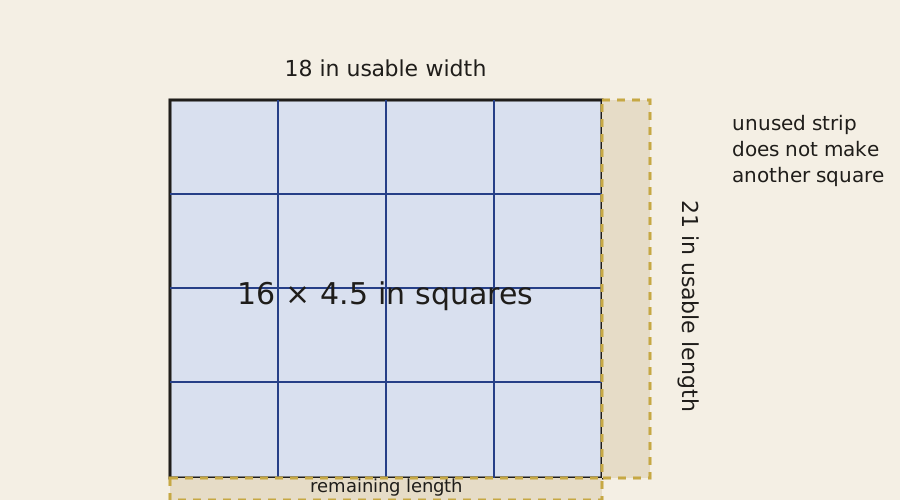
Calculation: Across: floor(18 ÷ 4.5) = 4 squares. Along: floor(21 ÷ 4.5) = 4 squares. Yield = 4 × 4 = 16 squares per fat quarter. Fat quarters required = ceiling(31 ÷ 16) = 2. Extra capacity = 2 × 16 − 31 = 1 square.
- Squares per fat quarter: 16
- Fat quarters required: 2
- Extra square capacity: 1
The floor operation matters. The 21 inch length is long enough for four 4.5 inch squares because four squares use 18 inches, but it is not long enough for a fifth square. The remaining three inches do not become another square and are not automatically combined with scraps from a different piece.
Compare the count and buy
| Required squares | Fat quarters to buy | Purchased capacity | Extra capacity |
|---|---|---|---|
| 8 | 1 | 16 squares | 8 |
| 16 | 1 | 16 squares | 0 |
| 17 | 2 | 32 squares | 15 |
| 31 | 2 | 32 squares | 1 |
The table makes the purchase threshold visible. A requirement of 16 squares uses one measured fat quarter, while 17 crosses the threshold and requires a second piece under this grid. That second piece has substantial extra capacity, but the extra is only useful for the same square size unless you independently confirm another cut will fit.
If the product’s actual dimensions differ from the example, replace the example width and length before buying. A package name can identify a format without proving the usable rectangle inside it. The calculator’s result is therefore a measured-piece estimate, not a universal promise about every fat quarter.
Count the required identical squares, measure the usable rectangle, calculate the uniform grid yield and round up to whole fat quarters. Keeping those steps separate prevents leftover capacity from being mistaken for a second cut plan.