
Binding is the narrow finished edge that covers the raw perimeter of a quilt. The amount of fabric you need depends on the edge you will actually bind, the width of the strips you will cut, the usable width of the fabric, and the single extra amount you choose for joining and closing the binding.
A reliable estimate starts after the quilt has been trimmed. That keeps the measurement tied to the edge the binding must cover, instead of a pattern size or an earlier unfinished top. The example below shows how to turn that measurement into strips, theoretical yardage and a purchase amount without rounding the arithmetic too early.
When you need a binding fabric decision
Use this method when you are making straight-grain strips from yardage and need to decide how much fabric to buy. It is most useful after quilting and trimming have established the final edge. It also helps when comparing two fabrics with different usable widths, because the strip count can change even when the quilt itself does not.
This is a whole-strip estimate. It does not promise the exact length of the sewn binding after every join, corner turn or closing seam. Keep the total extra as one selected input; do not add several alternative recommendations together or treat the extra as a per-seam allowance.
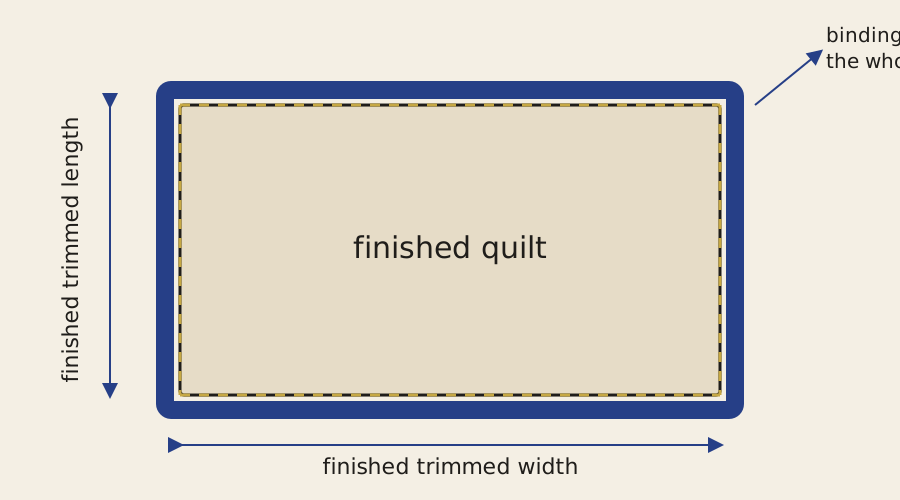
Measure the right inputs
- Trim the quilt and measure its finished width and length at the edge that will receive binding.
- Choose the cut strip width before folding. Record the width in inches, not the finished folded width.
- Measure the usable fabric width after excluding selvage or any edge you will not cut. A bolt label is not a substitute for this measurement.
- Choose one total extra for joins, corners and closing. If a shop or method uses a purchase increment, enter that increment separately after the theoretical amount is calculated.
The calculator accepts decimal inches in eighth-inch steps. For example, enter 2.25 for 2 1/4 inches. The usable WOF is the width available for cutting strips; it is not the nominal width printed on a bolt. If the fabric is directional or the method requires a different orientation, confirm that before using a straight-grain strip estimate.
Work through an example
Perimeter = 2 × (finished width + finished length). Target binding length = perimeter + one selected total extra. Strip count = ceiling(target binding length ÷ usable WOF). Theoretical yardage = strip count × cut strip width ÷ 36.
Independent example
- Finished quilt
- 54 × 70 in
- Cut strip width
- 2.25 in
- Usable WOF
- 42 in
- Total extra
- 16 in
- Purchase rounding
- 0.25 yd
Calculation: Perimeter = 2 × (54 + 70) = 248 in. Target binding length = 248 + 16 = 264 in. Strip count = ceiling(264 ÷ 42) = 7 strips. Theoretical yardage = 7 × 2.25 ÷ 36 = 15.75 ÷ 36 = 0.4375 yd.
- Target binding length: 264 in
- Strips to cut: 7 strips at 2.25 in
- Theoretical quantity: 0.4375 yd, displayed as 0.44 yd
- Recommended purchase: 0.5 yd when rounded up to 0.25 yd
The unrounded 0.4375 yd is kept through the calculation. Only after that value is known is it rounded upward to the seller’s 0.25 yd increment. The theoretical quantity describes the strip calculation; the recommended purchase is the amount selected for buying.
Compare the result and buy
| Scenario | Usable WOF | Strip width | Strips | Theoretical | Purchase at 0.25 yd |
|---|---|---|---|---|---|
| Base example | 42 in | 2.25 in | 7 | 0.4375 yd | 0.5 yd |
| Wider fabric | 44 in | 2.25 in | 6 | 0.375 yd | 0.5 yd |
| Wider strips | 42 in | 2.5 in | 7 | 0.4861 yd | 0.5 yd |
The table shows why usable width and strip width belong in the decision. Six strips from 44-inch usable fabric require less theoretical material than seven strips from 42-inch fabric, but both examples round to the same half-yard purchase. A change in the purchase increment can change that final buying amount.
Before cutting, compare the recommended purchase with the actual fabric width and the way you will join and finish the binding. If the joined strip does not comfortably reach the quilt edge, stop and check the measured perimeter, the selected total extra and the fabric’s usable width rather than silently adding an unrecorded reserve.
Measure the finished quilt, calculate one perimeter-based target, convert that target into whole WOF strips, and keep theoretical yardage separate from purchase rounding. That gives you a traceable buying decision while leaving method-specific joining choices visible.