
A batting package can look close to the size you need and still fail in one direction. The useful question is geometric: do the listed package dimensions cover the required batting rectangle as listed, or does a 90-degree rotation make the fit work? If neither orientation covers the target, the shortfall tells you how far the package is from the entered requirement.
This check belongs after you have established the batting target. It does not choose a brand, infer loft or stretch, or search a product catalog. Enter the dimensions printed for the package you are considering and keep the target separate from the package rectangle.
When a package-fit check helps
Use the check when you already know the required batting width and length and are comparing one package against that target. It is especially helpful when a package is wider in one direction and longer in the other, because the same rectangle may fit after rotation even when it does not fit as listed.
Keep the batting target tied to the quilt project. If the target comes from the batting-size calculator, it should already include the overhang you intend to use. If a quilter, pattern or batting manufacturer gives a different requirement, enter that explicit requirement rather than letting a package name stand in for a measurement.
Record both rectangles
- Enter the required batting width and length for the quilt. Do not enter the backing size unless it is also the batting target.
- Read the package width and length from the actual package or product listing you intend to buy.
- Calculate with the package as listed, then allow the tool to check the rotated orientation.
- If neither orientation fits, read the shortfall from the closer orientation and decide whether another package or a joining method is appropriate.
The calculator compares dimensions only. It does not treat a package labeled Queen, Twin or King as a fixed standard, and it does not infer extra room for quilting, shrinkage, loft or stretching. Actual package dimensions remain the controlling inputs.
Work through an example
A package fits as listed when package width ≥ required width and package length ≥ required length. It fits when rotated when package length ≥ required width and package width ≥ required length. If neither orientation fits, compare the total dimensional shortfall for the two orientations and report the closer one.
Independent example
- Required batting target
- 68 × 88 in
- Package listed size
- 90 × 72 in
- Allowed check
- As listed and rotated
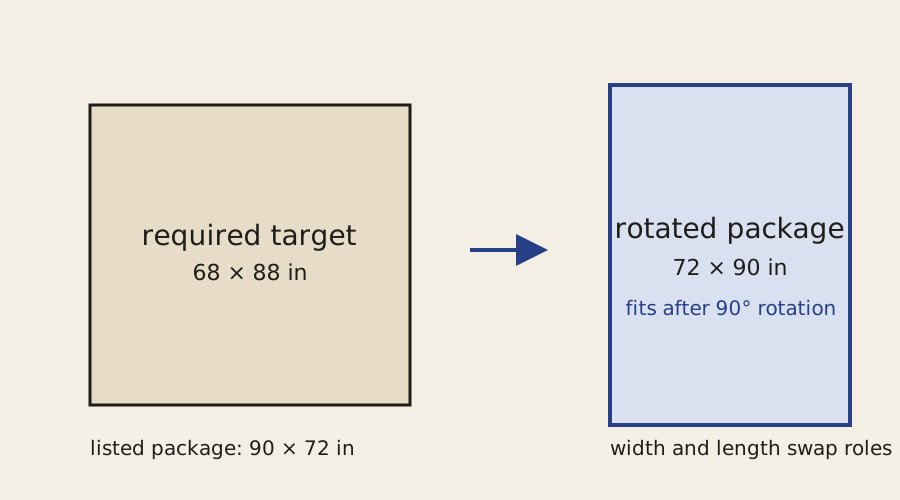
Calculation: As listed: 90 ≥ 68, but 72 < 88, so the package does not cover the target in that orientation. Rotated: 72 ≥ 68 and 90 ≥ 88, so the package covers the target after a 90-degree rotation.
- Result: Package fits
- Fitting orientation: rotated
- Required target: 68 × 88 in
- Package size: 90 × 72 in
The rotation changes which package dimension supplies the target width and length; it does not change the amount of batting in the package. This is why both dimensions must be recorded instead of checking only the larger side.
Compare the package and buy
| Package listed size | As listed | Rotated | Decision detail |
|---|---|---|---|
| 72 × 90 in | Fits | Fits | Both orientations cover the target |
| 90 × 72 in | Does not fit | Fits | Rotation supplies 72 × 90 in coverage |
| 66 × 90 in | Short by 2 in width | Short by 22 in length | Closer orientation still misses the target |
A package that fits is a dimensional match, not a product recommendation. Before cutting, confirm the package is the product and loft you intend to use and that the quilting method allows the entered overhang. If the package is short, the calculator reports the gap; it does not decide whether a join is acceptable.
When the required target itself is uncertain, calculate that target first. A package-fit result cannot correct an incorrect quilt measurement, and it should not be used to hide a difference between batting overhang and backing overhang.
Treat the package and the quilt as two measured rectangles. Check the listed orientation, check the rotation, and use the shortfall only as a precise description of what remains uncovered.